Raising CPA to your CSS isn't a cost hike. It's how you unlock Shopping scale.
Most merchants treat CPA as a fee to negotiate down. The ones who grow on Google Shopping treat it as the lever that decides how hard their Comparison Shopping Service can compete in auction.
The real question isn't “how much CPA?”
In a CSS model, the merchant doesn't buy Google Ads in isolation. They pay the CSS a commission on GMV, a CPA percentage. That percentage is also the channel COS: commissions ÷ GMV = CPA%.
So when you raise CPA%, COS goes up. That sounds like bad news, until you remember what the CSS actually does with that commission. It is the economic ceiling for bidding: the margin that makes higher CPCs, looser tROAS targets, and smarter seasonality adjustments sustainable.
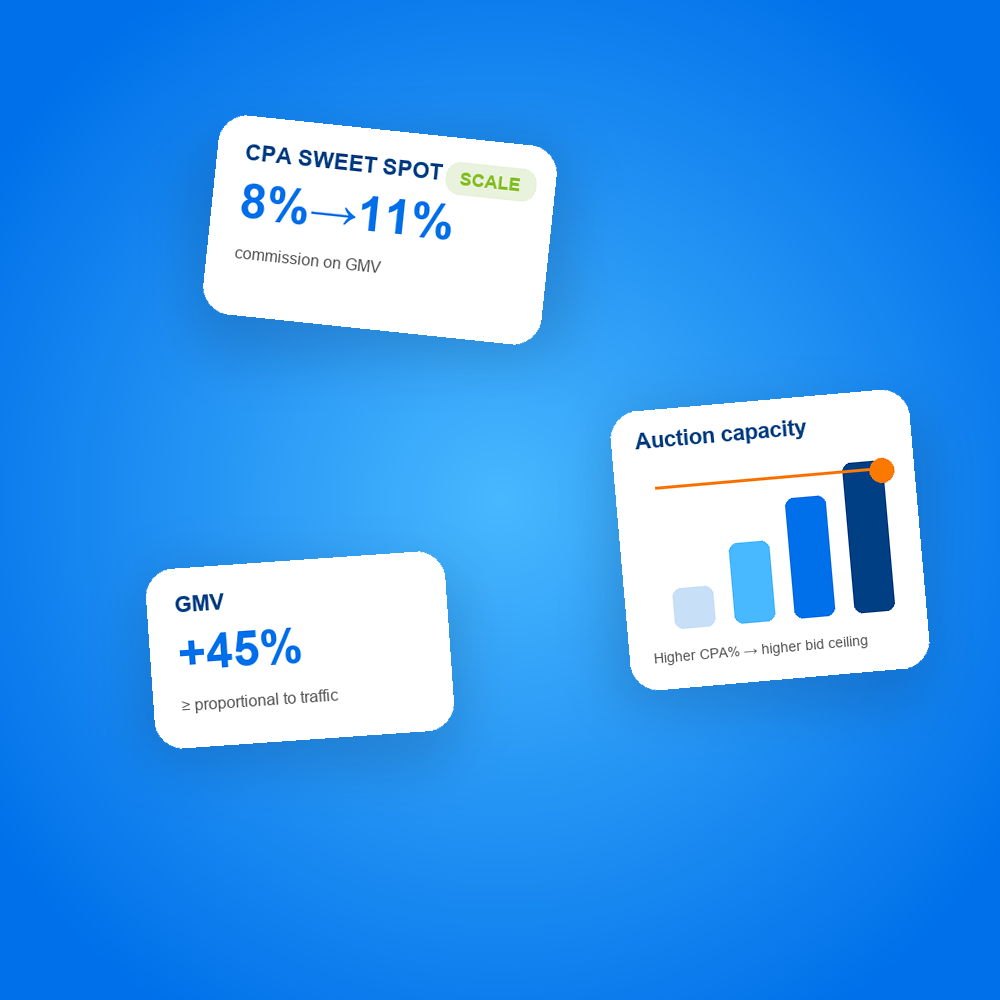
Raise CPA%, and you don't “buy GMV” directly. You buy auction capacity: the ability for your partner to stay in competitive Shopping auctions, reopen SKUs that were previously under-marginal, and let the algorithm learn a new spend regime.
How CPA% becomes auction strength
On a stylized click, CSS economics look like this:
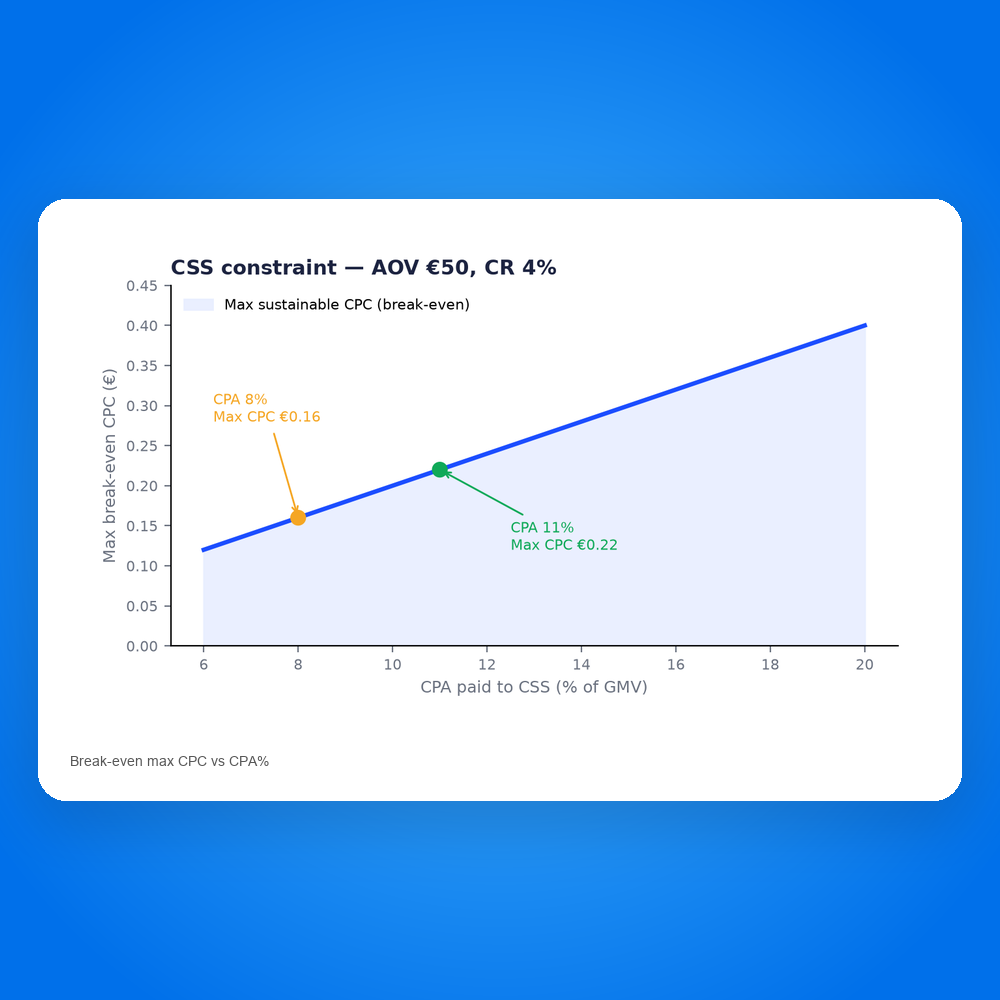
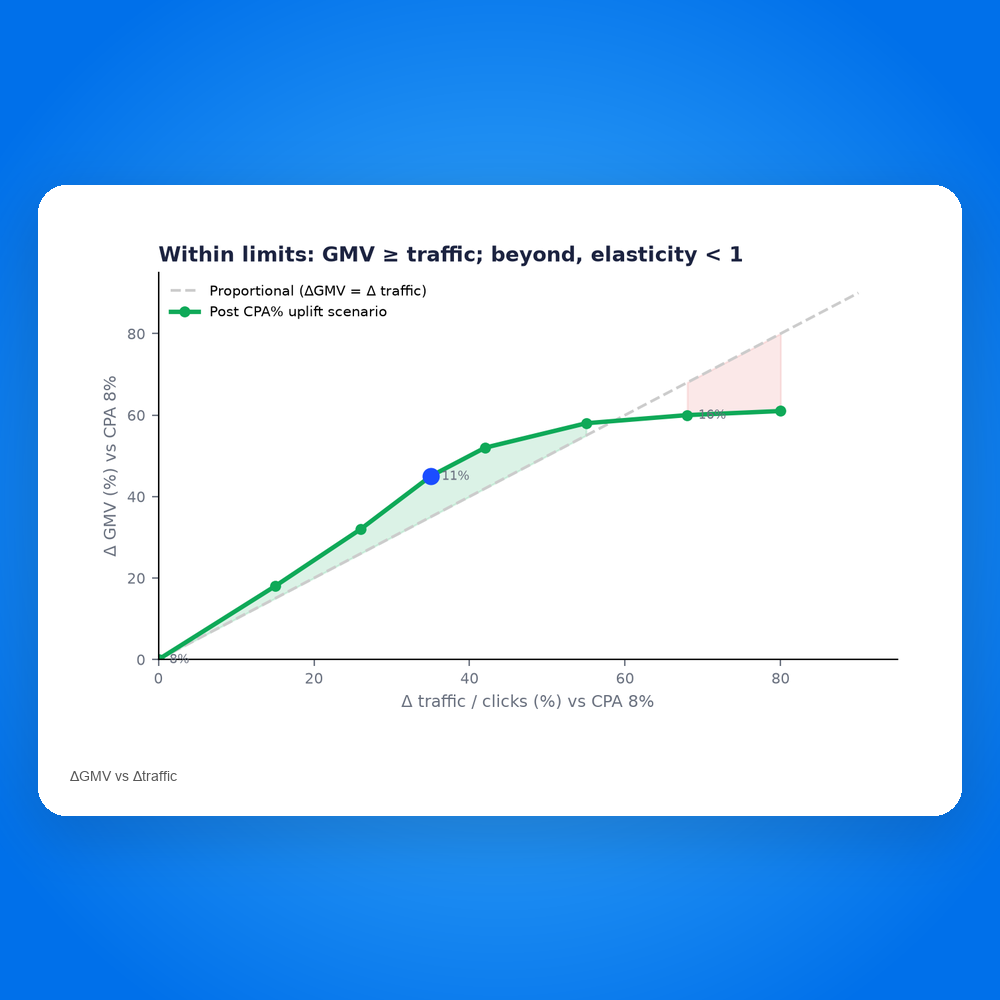
Higher CPA% → higher expected margin per click for the CSS → higher sustainable CPC and/or more permissive targets → more traffic. Where conversion rate and AOV hold, GMV follows. Within limits, GMV typically grows at least as fast as traffic, sometimes faster.Break-even max CPC rises with CPA% (illustrative: AOV €50, CR 4%)In practice, a responsive CSS can immediately:
Accept higher CPCs on competitive Shopping auctions
Relax tROAS (or equivalent) to give the algorithm room to explore
Use seasonality adjustments when conversion signal supports a push
Reopen SKUs and price bands previously cut as under-marginal
What happens after you raise CPA
A CPA uplift is a business decision. Google only “sees” it once campaigns and bidding policy actually change. Speed matters: an hourly operating loop can move in hours; a slow manual setup can take days.
Then the sequence usually looks like this:
Auction expansion: impression share and clicks rise; average CPC often rises too as you buy queries you previously left to competitors.
Catalog mix shifts: with more margin per conversion, SKUs that were too tight can come back. Selective uplifts (high-intent categories) beat blind global bumps.
Algorithm learning: more aggressive spend can generate more observed conversions, which legitimizes further spend, as long as demand elasticity and feed quality hold.
Diminishing returns: past a point, extra CPA% buys colder traffic and saturating SKUs. Marginal GMV slows; without governance, CSS incentives can diverge from merchant net.
CPA% is channel COS and the CSS bidding ceiling, not just a fee to cut
Pair the rate change with campaign protocol and fast stop/go monitoring
Goal: operate in the CPA range that maximizes value for both sides
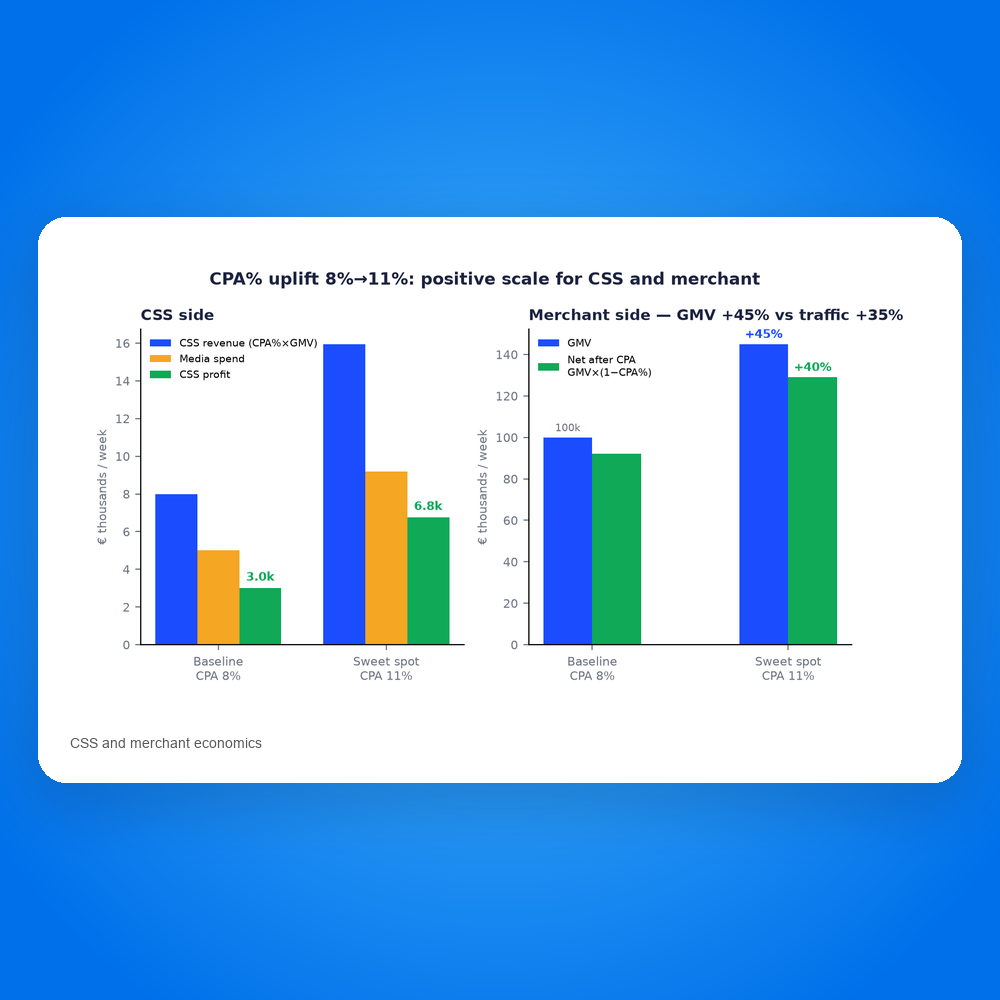
A higher CPA% is not simply an extra cost. It enables the CSS to invest more aggressively, unlocking incremental GMV. As long as growth outpaces the commission step-up, merchant net goes up, and the CSS earns more on a larger base.
The sweet spot: CPA 8% → 11%
Here's the scenario that flips the “higher CPA = worse deal” intuition.
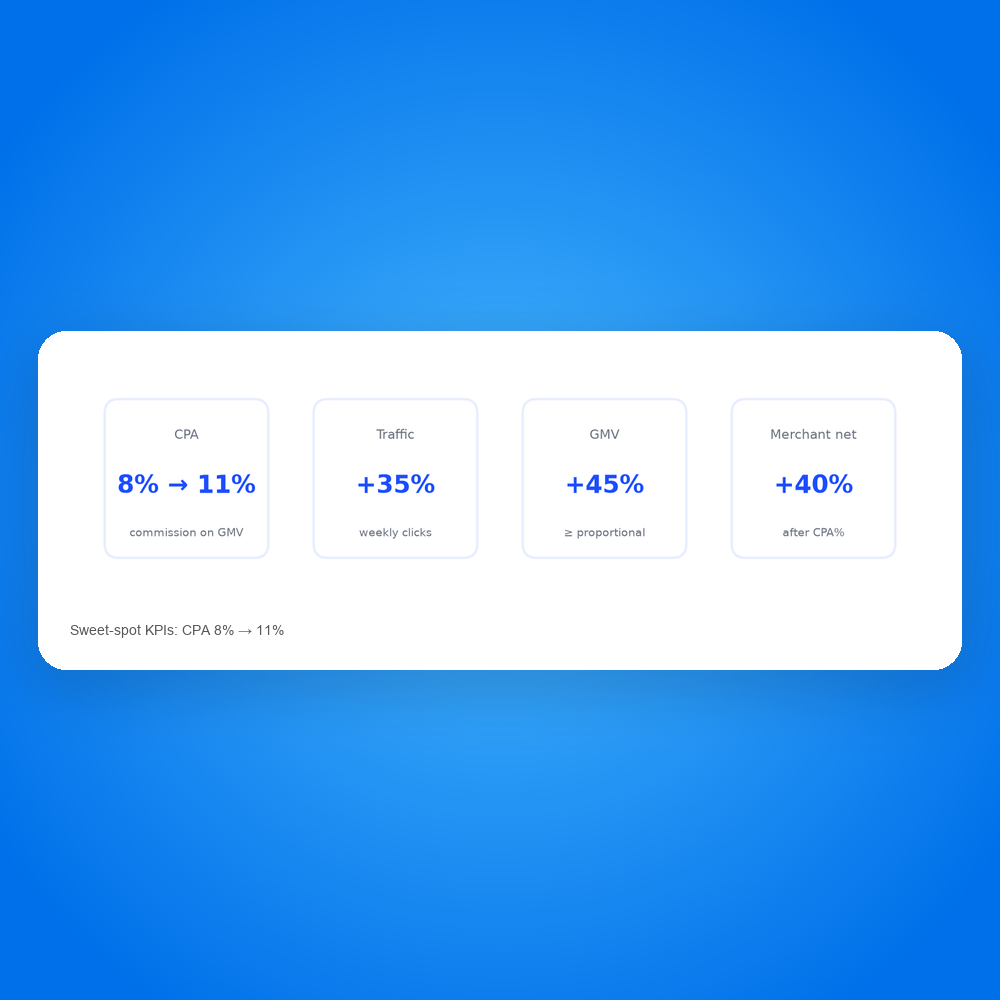
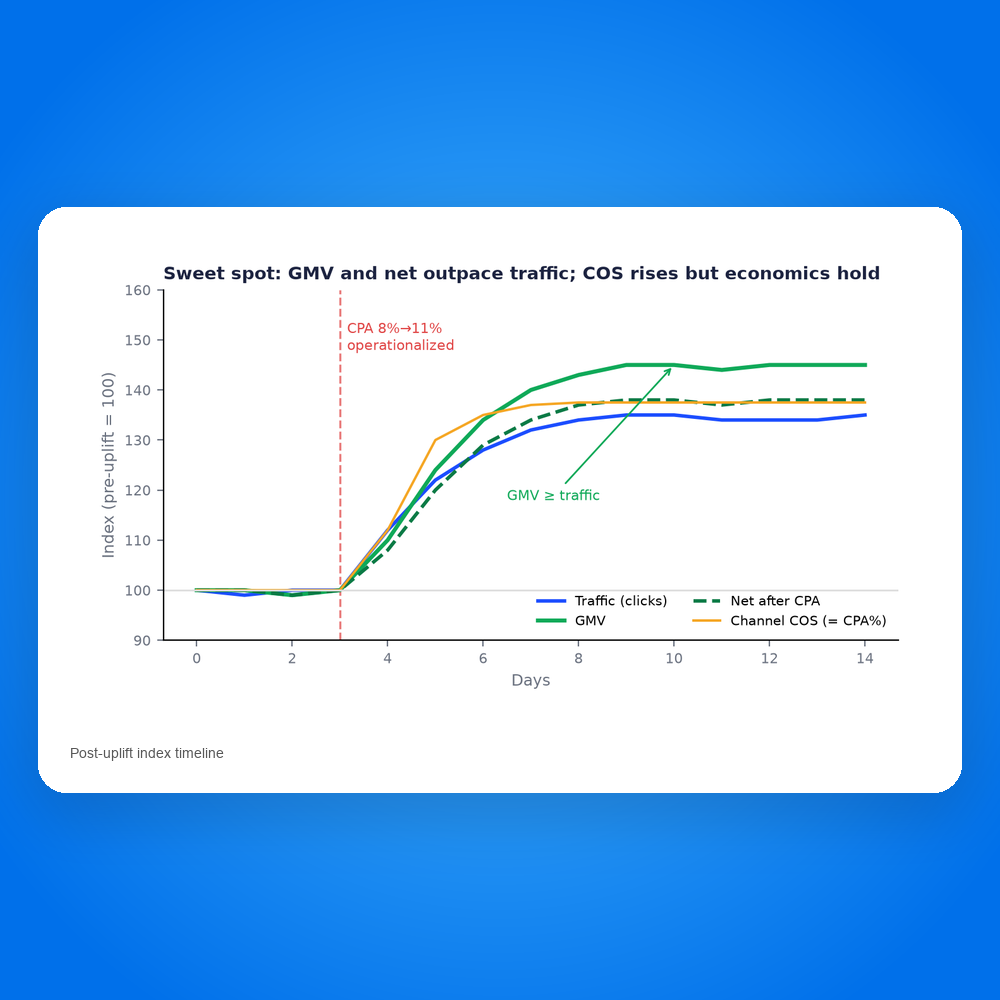
Illustrative weekly economics: traffic +35%, GMV +45% (more than proportional), channel COS from 8% to 11%. Net after commission still rises about +40%. The merchant “pays” three percentage points more COS, and buys a revenue engine that more than compensates.Sweet-spot KPIs: CPA 8% → 11%CSS revenue and merchant net at CPA 8% vs 11%CSS vs merchant: same lever, different scoreboard
The merchant watches orders, GMV, and channel COS. The CSS watches CPC, commissionable conversions, hourly profit, and risk limits. Raise CPA and the merchant may see “higher acquisition cost”; the CSS sees “room to scale.”
The right translation: the merchant is buying an option on scale, not a GMV guarantee. That option pays when:
The previous CPA was capping the CSS in auction
Shopping demand isn't already saturated
The CSS pushes high-probability SKUs, not raw volume for its own sake
Monitoring is fast enough to pull back when conversion signal disappoints
Where value is created, and where it isn't
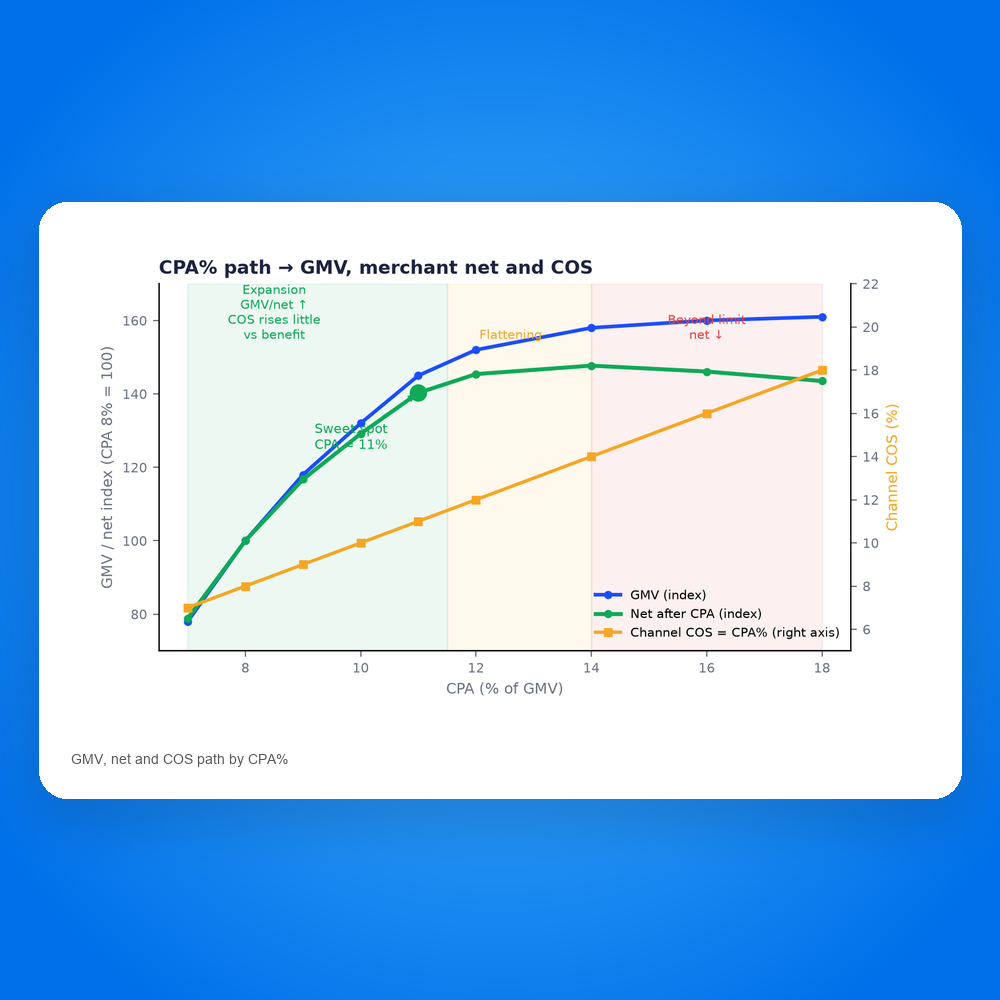
On a pure commission model, COS equals CPA% by construction. What matters is how GMV and net move as you step COS up:
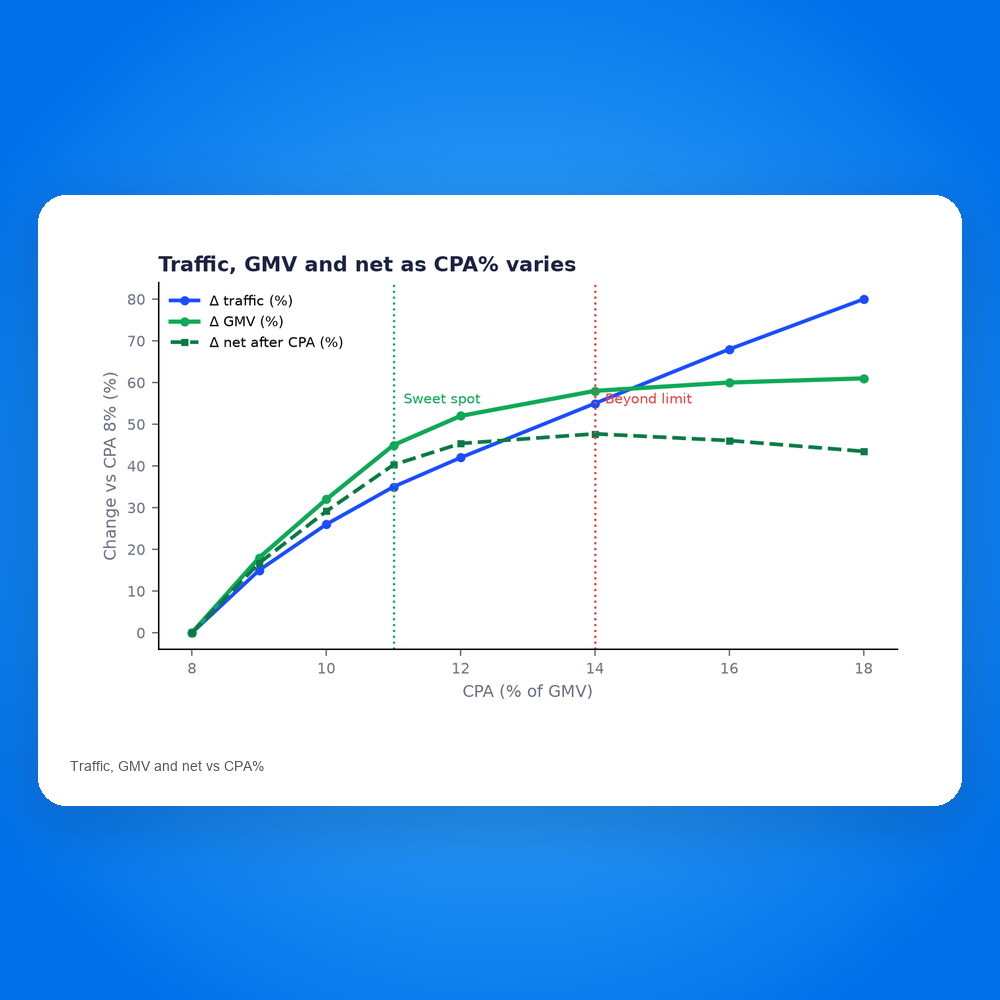
Expansion band (~8–11%): GMV accelerates, net rises sharply; COS up a few points, economics improve.
Flattening (~11–14%): some GMV left; net barely moves; the benefit slope fades.
Beyond limit (>~14–16%): traffic may still rise; GMV saturates; net falls. The uplift becomes pure cost.
As CPA% rises: GMV, merchant net, and COS. Green zone = typically positive upliftΔGMV vs Δtraffic as CPA% changes: above the diagonal means GMV grows at least proportionallyAfter 8% → 11%: traffic, GMV and net rise; COS rises but economics stay positiveTraffic, GMV and net vs CPA% level: find the range, don't just minimize the rateHow to use CPA uplift like a growth lever
Treat a CPA increase as a controlled elasticity test, not a permanent switch you forget about.
Set a clear baseline: GMV, spend, CR, AOV, COS on pre/post windows
Pair the uplift with a campaign protocol: targets, seasonality rules, risk limits
Define stop/go: marginal GMV vs the marginal cost of the higher CPA%
Prefer selective uplifts (country, category, price band) over blind global bumps
Measure reaction speed: how fast the CSS translates the new rate into auction behavior is as important as the rate itself
What to watch out for
Contract changes without campaign changes: zero effect
Volume chasing: CPC up, CR down, GMV flat: you pay more for the same output
Multi-CSS wars: simultaneous different uplifts that cannibalize each other in auction
Post-click friction: checkout, price, or shipping problems won't be fixed by higher CPC
Optimizing only for commissionable conversions when that diverges from merchant net (returns, discounts)
Bottom line
A CPA uplift shouldn't be judged as an isolated increase in acquisition cost. It's a strategic lever that expands your CSS's ability to compete for traffic and create incremental demand.
Inside the right range, higher CPA funds more investment: more traffic, more GMV, and higher net for the merchant, while the CSS grows revenue on a larger base.
The goal isn't to minimize CPA. It's to find and operate in the CPA range that maximizes value for both sides.
Note. Charts in this resource are illustrative economics for a stylized weekly scenario (including AOV €50 / CR 4% where noted). They are meant to explain the mechanism, not disclose absolute Booncy client figures.
Request more information
Have questions about this resource? Fill out the form and the Booncy team will get back to you shortly.